
A bag converter in Vietnam was running 0.04mm HDPE film for supermarket T‑shirt bags. The bubble oscillated side to side, the frost line shifted up and down, and the gauge on the finished roll varied by ±3 microns. The operator blamed the material. The root cause was cooling asymmetry — one side of the air ring was feeding more air than the other.
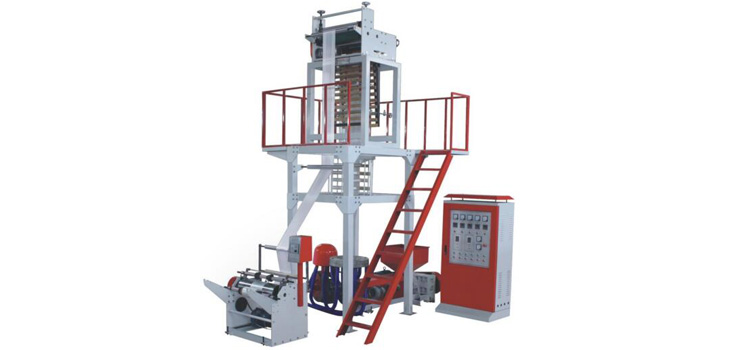
The blown film machine that processes HDPE, LDPE, and LLDPE relies on a stable bubble for uniform gauge. The Single Layer Blown Film Machine with a 30:1 L/D extruder, dual‑lip air ring, and adjustable haul‑off can stabilize the bubble within minutes when the correct steps are followed. This guide explains why HDPE is more sensitive than LDPE, how to center the air ring before starting a run, which melt temperature window prevents bubble breathing, and how to match blow‑up ratio to material.
LDPE has high melt strength and a low neck height. The bubble stabilizes quickly, even with modest air ring adjustment. HDPE has a long neck — the tapered section between the die and the bubble — and lower melt strength. As the polymer exits the die, it must be cooled symmetrically before it stretches to the final diameter. An air ring offset by 5mm will blow an HDPE bubble off‑center, causing the film gauge to vary by ±2‑3 microns across the width.
The blown film machine running HDPE requires the air ring to be centered within 2mm of the die axis. The dual‑lip design provides two air streams — a primary jet that immediately freezes the melt surface and a secondary flow that maintains bubble diameter. For LDPE, a single‑lip ring is sufficient; for HDPE, the dual‑lip ring is essential for preventing the long neck from becoming asymmetrical.
The screw L/D ratio matters. The 30:1 screw provides enough mixing length to homogenize HDPE which has a narrower molecular weight distribution than LDPE. A shorter screw may leave unmelted gel particles that act as stress concentrators, initiating a bubble tear.
Before the machine starts, the operator should center the air ring relative to the die lip. Use a dial indicator or a set of feeler gauges to measure the gap between the air ring and the die body at four points (0°, 90°, 180°, 270°). The variation should be no more than 0.5mm. If the ring is off‑center, the cooling air will push the melt toward one side, and the bubble will drift.
The air volume per zone must also be balanced. For a dual‑lip ring, set the primary air volume first. Adjust each of the four quadrants to within ±5% of the target flow. Observe the bubble for 30 seconds after each adjustment. A bubble that straightens after a quadrant adjustment confirms the imbalance was there.
If the bubble expands and contracts rhythmically by 20‑30mm in diameter, the primary air pressure is fluctuating. This is often caused by a clogged air ring manifold or a fan speed that is too low. Clean the air ring passages weekly with compressed air. For a 500mm die diameter, the airflow rate should be between 50 and 150 CFM per inch of die diameter. For a 600mm die at 1000mm bubble diameter, the primary air flow should be around 120‑150 m³/h.
HDPE has a melting range of 125‑135°C. The extrusion temperature is typically set to 190‑210°C to reduce viscosity and improve output. If the temperature is too high (above 220°C), the melt viscosity drops, the neck lengthens, and the bubble becomes prone to helical instability — the bubble spirals around the axis.
The frost line is the horizontal band where the film transitions from molten to solid. For HDPE, the frost line should be 8‑15cm above the air ring. If it is higher, reduce the melt temperature by 5°C increments. If it is lower, increase cooling air volume rather than raising the melt temperature.
| Material | Melt Temp Range | Frost Line Height | Bubble Stability |
|---|---|---|---|
| LDPE | 160‑180°C | 5‑10cm | High |
| LLDPE | 180‑210°C | 8‑15cm | Moderate |
| HDPE | 190‑210°C | 10‑20cm | Low |
| Recycled PE | 180‑200°C | 8‑12cm | Variable |
The die lip gap determines the initial film thickness before blowing. Uneven die gap (more than 0.05mm variation around the circumference) will produce a bubble that is thicker on one side. The thicker side cools slower, expands more, and the bubble pulls toward the thinner side. Measure the die gap with a feeler gauge at 12 points before every run. Adjust the die bolts to bring the variation below 0.02mm. A die gap set for HDPE (0.6‑0.8mm) is too tight for LDPE (0.8‑1.0mm).
The blow‑up ratio is the bubble diameter divided by the die diameter. For HDPE, the BUR should be 2:1 to 2.5:1. For LDPE, BUR can be 3:1 to 4:1. If the BUR is too low for HDPE (below 1.8:1), the bubble will be under‑inflated, and the film will have low mechanical strength in the transverse direction. If the BUR is too high, the bubble will be unstable, and the frost line will rise.
The haul‑off speed must be matched to the BUR. The formula is: lay‑flat width = (die diameter × BUR × π) / 2. For a 600mm die producing a 1200mm lay‑flat, the BUR is 2:1. The haul‑off speed is set by measuring the film thickness. Increase haul‑off speed to reduce thickness; decrease it to increase thickness.
If the haul‑off speed is set higher than the extrusion rate, the bubble will be stretched too thin. The neck will elongate, the frost line will drop, and the film will have low tear strength. The operator should measure the film thickness every 10 minutes during the first hour of a run and adjust the haul‑off speed in 2‑3% increments. A stable bubble requires the extrusion output, air volume, haul‑off speed, and winder tension to be in balance. Change one parameter and the other three will need recalibration.
Gauge variation appears as thick lines that repeat every 360° of bubble rotation (gauge bands) or random thick spots (spikes). Gauge bands are caused by die lip contamination, a damaged die, or uneven cooling. Spikes are caused by unmelted resin or air pockets.
For gauge bands, mark the thick band with a marker and rotate the bubble by hand. If the band stays in the same position relative to the bubble, the die is the problem. Remove the die and clean the lip with a brass scraper. If the band moves with the bubble, the air ring is unbalanced. Adjust the quadrant air volumes in small increments (5‑10 m³/h).
For thickness spikes, check the screen pack for clogging. A partial clog will cause the melt pressure to fluctuate, producing intermittent thick spots. Replace the screen pack if the pressure has increased by more than 10% from the baseline. Also check the resin for contamination. A single hard pellet that does not melt will stretch into a thin spot and cause a weak line in the film.
| Thickness Defect | Likely Cause | Fix |
|---|---|---|
| Gauge bands (periodic thick lines) | Uneven die gap or air ring imbalance | Clean die lip, recenter air ring, balance quadrant air volumes |
| Random spikes (sudden thick spots) | Unmelted resin, screen pack clogging, melt pressure fluctuation | Lower output rate, check melt temperature, replace screen pack |
| Wavy gauge (slow oscillation) | Haul‑off speed mismatch, winder tension too high | Reduce haul‑off speed, check dancer roller, lower winding tension |
| Thin streaks (longitudinal lines) | Die lip scratch, contaminant in melt | Remove die, polish lip, check screen pack for debris |
Air rings use ambient air for cooling. For HDPE, which requires rapid quenching to prevent crystallization, ambient air at 25‑30°C is acceptable. For LLDPE, which has a broader melting range, the cooling rate is less critical.
For high‑output lines producing HDPE at over 80 kg/h, chilled air (10‑15°C) can improve bubble stability by freezing the melt faster. The frost line drops, the neck shortens, and the bubble becomes less sensitive to drafts. However, chilled air can cause condensation on the die lip when the humidity is high, leading to die drool. If the machine is in a humid environment, use ambient air or install a dehumidifier in the air intake.
The cooling air should be filtered. Dust in the air stream will land on the melt surface, creating pinholes in the film. Clean the air filter weekly. For a bag converter running HDPE for produce bags, a pinhole defect will cause the bag to leak when filled with water.
When the bubble wobbles, the natural reaction is to adjust the air ring. The operator turns the quadrant valves one way, then the other, while watching the bubble. The bubble responds slowly — there is a 10‑15 second delay between air adjustment and visible bubble movement. By the time the operator sees the effect of the first adjustment, they have already made a second adjustment based on the original condition. The result is overcorrection and hunting.
The correct sequence: stop. Write down the air ring quadrant positions. Make one small adjustment (10‑15 m³/h) to one quadrant. Wait 30 seconds. Observe. If the bubble improves, repeat in the same direction. If it worsens, return to the original setting and try the opposite quadrant. Keep a log of air ring settings for each die and material. After a die change, the air ring quadrant positions will be different because the die lip geometry changes slightly with each cleaning.
Changing haul‑off speed while the bubble is wobbling will mask the root cause. The film thickness will change, which changes the bubble diameter, which changes the air volume requirement. The operator ends up chasing two variables at once. Stabilize the bubble with air ring adjustments first, then adjust haul‑off speed to hit the target thickness.
Ruian Ruikang Machinery has manufactured blown film extrusion equipment for flexible packaging applications. The Single Layer Blown Film Machine is designed for bag converters who run HDPE, LDPE, and LLDPE on the same line. The machine features a 30:1 L/D extruder, dual‑lip air ring for bubble stabilization, 0.008‑0.08mm thickness range, up to 1200mm film width, 70‑150 kg/h output depending on die diameter and material, and automatic surface winder with tension control.
A blown film machine that stabilizes an HDPE bubble on the first attempt, recovers from a wobble within minutes, and produces uniform gauge without periodic operator intervention keeps a packaging line running through the shift. For a bag converter who runs short runs of printed HDPE bags daily, the Single Layer Blown Film Machine with centered air ring, matched BUR, and consistent melt temperature delivers.
【Request a quote from Ruian Ruikang Machinery】
Send Ruian Ruikang your target film thickness, material type (HDPE, LDPE, LLDPE), and lay‑flat width to receive a Single Layer Blown Film Machine specification and bubble‑stabilization setup recommendation.