
Here's what no supplier wants to tell you upfront: most first-time buyers of a bubble film machine order too much capacity. Not in a "nice problem to have" way — more like a "we're running at 40% utilization and the ROI spreadsheet just fell apart" way.
I've walked into plants where a gleaming 2500 mm wide, five-layer co-extrusion line sat idle three days a week while the operator ran a tired single-layer machine because that's what the orders actually needed. The global air bubble film machines market was worth roughly USD 78.45 million in 2024 and is growing at a steady 4.80% CAGR, which sounds like a green light to go big. But that aggregate number hides the real story: demand is fragmented across bubble sizes, film widths, layer configurations, and end-use requirements that shift faster than most procurement cycles can respond.
So the real question isn't "how big should my machine be?" It's "what production flexibility will keep this asset profitable across multiple order profiles over the next five to seven years?"
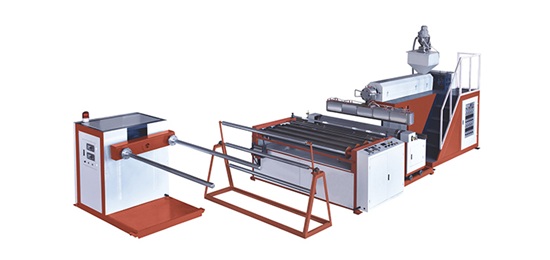
I get why it happens. When you're staring at a capital expenditure spreadsheet, the incremental cost of stepping up from a 1600 mm blown film extrusion line to a 2500 mm unit feels modest compared to the headline throughput numbers. The salesperson says "future-proof" and suddenly you're mentally booking revenue against capacity you haven't earned yet.
But here's the math that rarely makes the brochure. A 3000 mm line running at partial capacity burns electricity, floor space, and, critically, resin — the largest ongoing cost in any bubble film operation. Downgauging or running shorter production schedules on oversized equipment introduces bubble instability, uneven cooling, and gauge variation that turns perfectly good LDPE pellets into scrap. You get the worst of both worlds: high fixed costs and inconsistent output.
I once watched a plant in Gujarat fight a 12-month battle with film thickness inconsistency that traced straight back to an oversized die they'd been told was "standard for their target market." The machine itself was fine; it was simply the wrong machine for the order book they actually had.
This is where things get genuinely interesting, because the market isn't one thing. It's a collection of niches that reward different machine architectures.
Narrow-web lines (1000 mm–1600 mm) serve the e-commerce cushioning and small-part wrapping segment. The compostable bubble film market alone is projected to explode from USD 620 million in 2026 to over USD 2.4 billion by 2036, driven largely by e-commerce parcel volume. If your customer base leans toward logistics providers and fulfillment centers, a mid-width, quick-changeover line probably generates better returns than a wide-web behemoth designed for running commodity roll stock eight shifts a week.
Wide-web multi-layer lines (2000 mm and above) excel in heavy industrial packaging — furniture, appliance wrapping, construction material protection. The global air bubble film market reached about USD 2,887 million in 2025 and is forecast to hit USD 3,632 million by 2032. That's real growth, but it's not evenly distributed across all widths and bubble specifications. Larger bubbles (10 mm diameter, deeper profile) serve the furniture segment; smaller, denser bubbles protect electronics and glassware.
The configuration that made money for the guy in Dongguan running container-load orders to an appliance manufacturer might hemorrhage cash for you if your order book is 60% small-batch, custom-width bubble cushioning with three SKU changeovers per shift.
Most buyers fixate on width and throughput. Smart ones fixate on layers, because layer count directly shapes both material economics and product performance.
A single-layer air bubble film making machine is straightforward: one extruder, one resin stream, fewer things to maintain. The trade-off? You're locked into a single material profile, which means either virgin resin costs eat your margin or you blend recycled content and pray the bubble stability gods are smiling that day.
A three-layer co-extrusion line changes the economics entirely. You can sandwich lower-cost recycled LDPE between virgin outer layers, or put a high-performance skin on one side while the bulk of the structure uses standard-grade material. PCR (post-consumer recycled) LDPE is projected to command a 51.4% material demand share by 2026, and machines built with recycled-content compatibility in mind have a structural cost advantage that widens as resin prices cycle.
The catch? Multi-layer dies demand better temperature control, more precise air ring and cooling system tuning, and operators who understand how layer interfaces behave under draw-down. More layers aren't automatically better; they're better if your product mix exploits the material flexibility they unlock.
Here's a formula that's saved a few clients from expensive mistakes:
Hourly Area (m²) = Width (m) × Speed (m/min) × 60
Then multiply by your actual operating hours and, crucially, an honest utilization rate. Not 95%. Not 85%. Look at your last six months of shift logs and calculate the real number. I've seen operations where "85% theoretical" turned out to be 62% actual, once you account for changeovers, maintenance, scrap rework from bubble formation defects, and the thirty-minute warm-up drift period every Monday morning.
When that real number is plugged in, the 2500 mm machine that looked like a bargain suddenly produces only marginally more sellable output than a properly utilized 1800 mm line — and it's burning 40% more floor space and a larger extruder motor load to do it.
Earlier this year, I spent time reviewing the composite bubble film machinery space for a consultancy project, and one thing that stood out about Ruikang is that they don't push a one-size-fits-all flagship model.
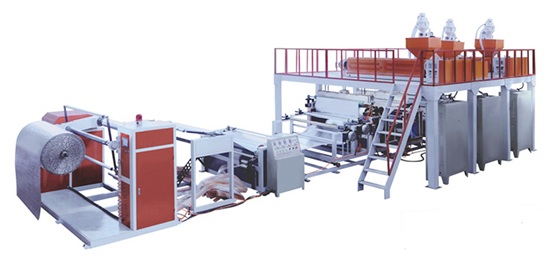
Their composite bubble film machines use a one-shot forming process that allows substrate lamination — Kraft paper, PE film, EPE foam, aluminized PET — in the same pass that creates the bubble structure. That matters because it eliminates a secondary laminating step that mid-sized converters often outsource, compressing both lead time and per-unit cost.
But the modularity is what sticks with me. The RK composite series spans screw diameters from Φ55/65 mm on the 1000 mm width all the way up to Φ100 mm tri-extruder setups on the 3000 mm model, with output ranging from roughly 70 kg/h at the compact end to 280 kg/h at the wide-web end. That's not a product line; it's a scaling ladder, and the design philosophy appears to be: pick the rung that matches your order book, and expand later if the volume justifies it.
The practical implication: you're not forced into an oversized die just because you want multi-layer capability. You can start at 1600 mm with a three-layer configuration, produce industrial-grade PE composite bubble film, and if demand grows toward the 2000 mm–2500 mm range, you're scaling within a familiar control architecture rather than learning a completely new machine personality.
Let me be blunt: if your business runs 250+ operating days a year on a single bubble specification — same width, same bubble diameter, same material — then a dedicated high-output line from a large-scale manufacturer probably serves you better. The economics of specialization are real. Surface cooling optimization via internal bubble cooling (IBC) systems can push output rates higher on lines designed around a fixed production envelope.
But that's not most converters. Most converters are juggling: 600 mm rolls for a furniture client on Tuesday, 1200 mm rolls with anti-static additive for an electronics packager on Wednesday, and a rush order of 1500 mm Kraft-backed composite for a construction supplier on Thursday. In that environment, quick-change versatility and resin adaptability stop being features and start being survival requirements.
The alternative comparison people sometimes miss: air pillow systems (on-demand inflatable packaging). These are brilliant for end-user fulfillment centers — blow cushions at the packing station, cut warehouse space, lower freight cost. The on-demand market is growing fast, with broader adoption driven by warehouse space reduction and labor savings. But they're a completely different animal. Air pillows don't give you wide-web roll stock for wrapping furniture, don't laminate substrates, and can't run recycled-content blends at the same throughput levels. If you're a film converter selling to industrial buyers, you need extrusion capability — just the right amount of it.
There's one metric that will tell you within a month whether your machine is right-sized: scrap rate as a percentage of total resin consumed. On a well-matched line running steady-state production with properly trained operators, scrap should settle somewhere in the 3–6% range, accounting for startup, grade transitions, and occasional bubble collapse events.
On an oversized line running short campaigns, scrap can drift past 10–12% without obvious alarms. Why? Because bubble stabilization takes longer on a wide die when the melt isn't filling the die gap uniformly, and every transition between widths or formulations generates a longer tail of off-spec material. Temperature fluctuations across the die face create thickness variation that the downstream winding system can't compensate for, and operators start adjusting the haul-off speed to chase gauge targets — which creates its own cascade of tension and winding issues.
I've been in plants where a single oversized line was generating more scrap tonnage monthly than two correctly sized lines combined, and nobody had run the numbers because the production manager was measuring "output" without subtracting what ended up in the regrind bin.
A right-sized line isn't the one that hits peak theoretical output. It's the one where:
The die runs at 75–85% of its maximum width most days, leaving headroom for occasional larger orders without paying for capacity you never use.
Changeovers between bubble specifications take under 45 minutes because the PLC recipe management stores proven parameter sets, and the machine's mechanical design doesn't force a full die disassembly to switch bubble roller configurations.
Your actual utilization rate (real output / real capacity during scheduled hours) stays above 70%, and ideally above 80%, across a rolling quarter.
The machine's recycled material tolerance matches your resin sourcing strategy, so you're not forced into virgin-only purchasing when PCR blends would cut material cost by 15–20%.
The machines that make money aren't the biggest ones on the factory floor. They're the ones whose capacity curve most closely traces the order book. Everything else is either idle iron or scrap yard in waiting.
Buy for what you'll actually run, not for what the capex spreadsheet wanted to justify. The difference shows up in every month-end material variance report.